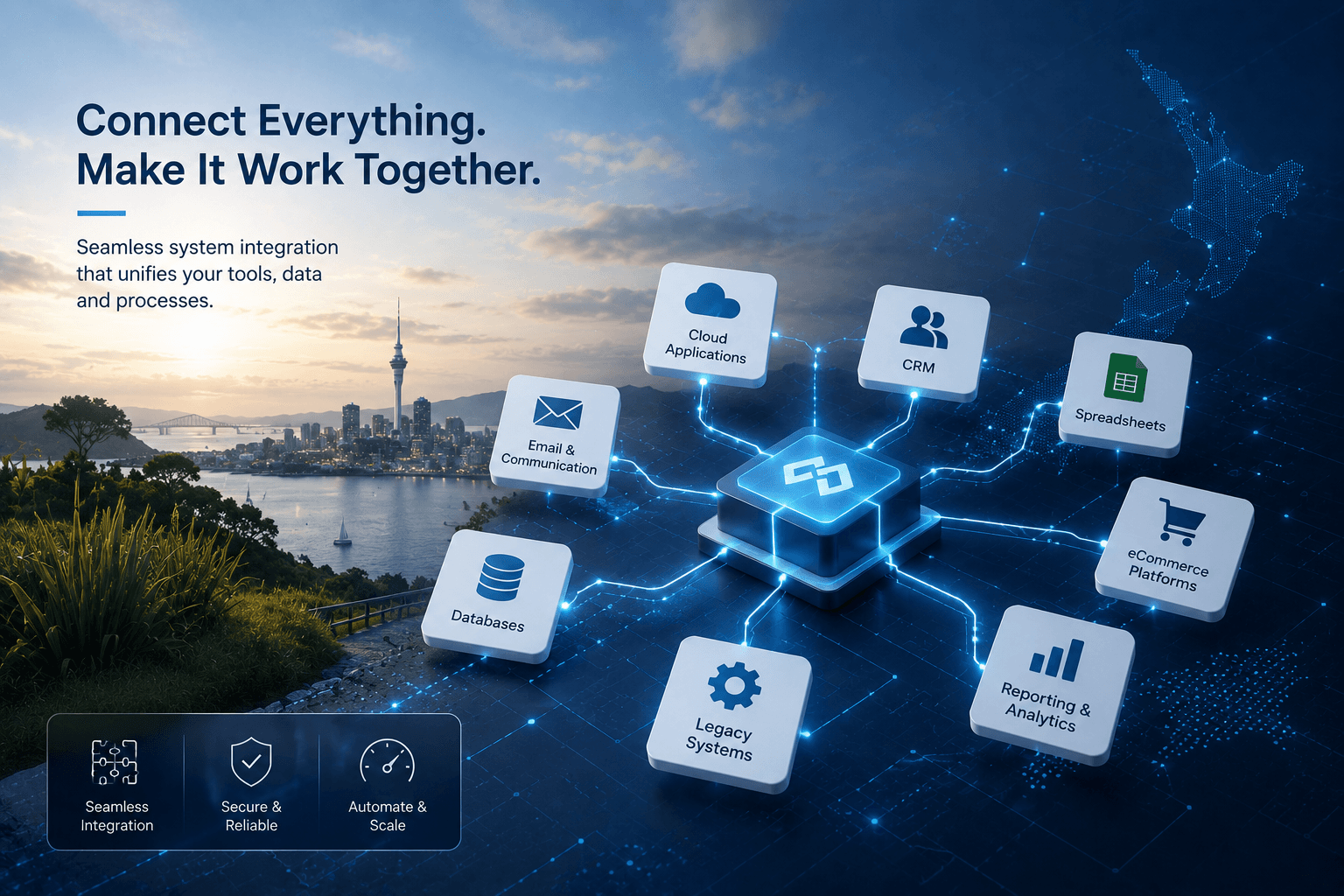
System Integration · New Zealand
System Integration for
NZ Businesses
Your website, CRM, accounting software, and inbox are all running — but none of them talk to each other. We build the connections so data flows automatically, double-entry disappears, and your team stops wasting time moving information between tools.
One update. Every system.
When your tools are properly connected, the whole business moves faster — with fewer errors and less overhead.
Source of truth — one update flows everywhere else automatically
Manual re-entry once your systems are properly connected
Years of enterprise integration experience behind every project
Common integration scenarios we solve
These are the most frequent disconnections we fix for NZ businesses — often as part of a wider CRM setup or automation project.
CRM ↔ Accounting
When a deal closes in your CRM, an invoice is automatically created in Xero or MYOB. Payment status syncs back. No manual entry, no mismatched records.
Website ↔ CRM
Every form submission, quote request, and contact enquiry from your website flows straight into your CRM with full context — source, page, and timestamp included.
E-commerce ↔ Back Office
Orders from Shopify or WooCommerce create records in your accounting and fulfilment systems automatically. Stock levels stay in sync across all channels.
Email & Calendar Sync
Emails and calendar events linked to the right contact and deal — automatically. Your team sees the full picture without switching between apps.
Reporting Aggregation
Data from your CRM, accounting, and website pulled into a single dashboard automatically. One view of your business — no manual exports, no spreadsheet hell.
Custom Event Triggers
Any event in any system — a new order, a status change, a payment received — can trigger actions across your entire tech stack via webhooks and API connections.
How we approach it
Integration Audit
We map every tool you use, what data lives where, and where the manual hand-offs are happening. This tells us exactly what needs connecting.
Architecture Design
We design the integration architecture — which tools connect directly, which go through a middleware layer, and how data is mapped and transformed.
Build & Test
We build the connections, test every flow end-to-end, and handle edge cases (errors, retries, duplicate prevention) before anything goes live.
Go-Live & Monitor
We manage the go-live, monitor the flows for the first two weeks, and hand over with clear documentation so your team understands what runs.
Common questions about system integration
How much does system integration cost in New Zealand?
Integration costs depend on the number of systems being connected and the complexity of the data flows. Connecting two tools via a standard integration (e.g., CRM to Xero) typically starts from $2,500–$5,000 NZD. Multi-system integrations with custom data mapping, error handling, and ongoing monitoring range from $8,000 to $25,000+. All projects are fixed-price — you know the number before we start.
Can you connect our software to Xero?
Yes — Xero integration is one of the most common projects we deliver for NZ businesses. We connect job management systems, CRMs, e-commerce platforms, and custom software to Xero for automatic invoice creation, contact sync, and payment status updates. We handle the full chart-of-accounts mapping to make sure transactions land correctly from day one.
What tools and platforms can you integrate?
We work with most business software that has an API. Common integrations include: Xero, MYOB, HubSpot, Salesforce, Zoho, GoHighLevel, Shopify, WooCommerce, Google Workspace, Microsoft 365, Slack, Zapier, Make, ServiceM8, Fergus, Calendly, Stripe, and custom-built applications. If you are unsure whether your platform can be connected, ask — the answer is usually yes.
Is Zapier or Make suitable, or do we need custom API work?
For straightforward connections between widely-used SaaS tools, Zapier and Make are often the right choice — fast to build and easy to maintain. For high-volume flows, complex data transformations, legacy system connections, or bespoke business logic, custom API integration is typically more reliable and cost-effective over time. We recommend the right approach for your specific situation.
What happens if an integration breaks?
A well-built integration includes error handling, logging, and alerting from day one — so you know immediately when something goes wrong rather than discovering it weeks later during a reconciliation. We build these safeguards in as standard, and our ongoing support plans include monitoring and incident response.
Where to look next
Industries we apply this in
Specialist pages
Case studies
From the blog
Connect everything. Eliminate double-handling.
Book a free 30-minute call with our NZ-based team. We will map your current tools, identify the highest-friction disconnections, and tell you exactly what it would cost to fix them.
Book a Free Audit